Wednesday, 24 September 2014

A cheerful chuckling chappie

Leave a Comment


Back in 1995 my wife and I visited Northern Ireland. We spent a weekend in Belfast, hardly a tourist mecca, but then again, not as bleak a city as it is often painted. Anyway its people not places that make a destination and the Irish overwhelm you with their unrelenting hospitality in both the north and the south of this enchanting country.

But for all that, Belfast was a bit different. It was incongruous for instance to hear people tell you in a broad Irish accent that they were “British to the core,” and yet that is what so many were like in Northern Ireland. Not all of course, hence the aggravation, but those who were pro-British tended to flaunt their stance. Many flew the Union Jack above their homes. Some residents painted the kerbs outside their dwellings red, white and blue; sometimes whole streets were so adorned.

And back then they had these ridiculous marches. While we were there the Apprentice Boys marched. I assumed this would be a group of young lads marching to celebrate that they were employed in a worthwhile trade. I couldn’t have been more wrong. The “boys” were well into their seventies, and were marching to celebrate some remote victory, Protestant over Catholic, that had occurred centuries ago. They teasingly marched into Catholic areas to taunt and provoke. These areas were totally devoid of Union Jacks or painted kerbs I might add. Tensions would mount and sometimes overflow into violence. It all seemed so unnecessary.

On Saturday afternoon we drove our rental car to nearby Antrim and, sitting in a park by a lake, we struck up a conversation with an Irishman who told us in no uncertain terms that he was “pro-British.” He was a bit critical of New Zealand because of our Catholic, pro-republican prime minister at the time, Jim Bolger, but he was an amusing conversationalist and we enjoyed our interlude with him. It soon became clear that his great hero was Dr. Ian Paisley. I expressed interest so he asked me if I would like to meet the reverend gentleman in person. Now I’d never had much time for Paisley, but the opportunity to meet a world figure was compelling, so I agreed that I would. Our man said all we needed to do was to go to Paisley’s church in the heart of Belfast the next morning and we could see and meet the great man in the flesh. He said he would inform the church elders that we were coming.
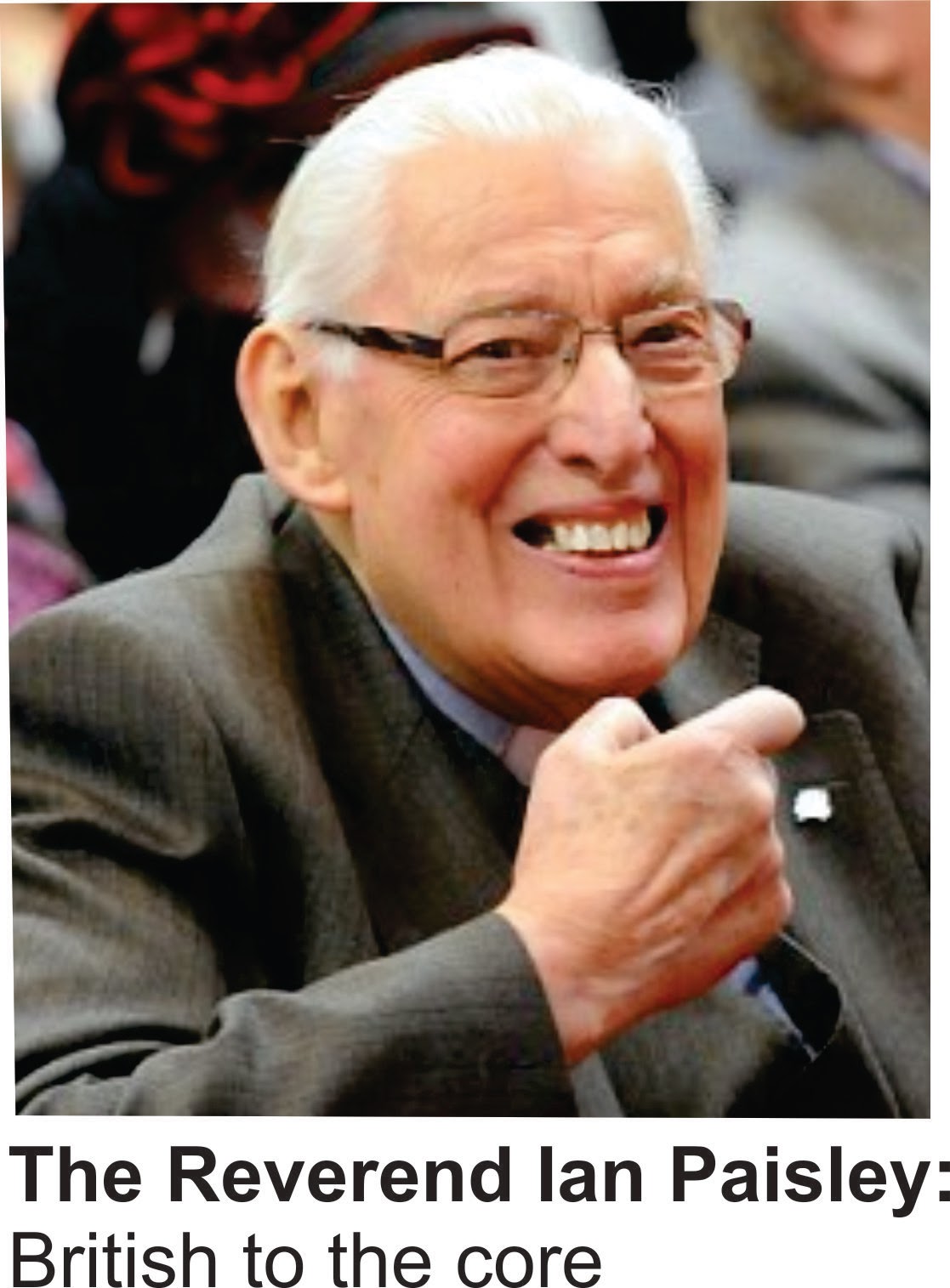

The church was the Free Presbyterian Church of Ireland and the service was to start at eleven. We arrived at about a quarter to eleven and were immediately conspicuous by our attire. Without exception all the women were wearing frocks and hats, and the men, suits and ties. In stark contrast Marion and I had open neck tops, casual slacks and sneakers. For all that we were made very welcome and ushered to very good seats in this large modern church.

I had expected that the area around the church would be surrounded by British army personnel and that Paisley would arrive in an armoured car; but this was not the case. Everything was calm and peaceful and there was not a soldier in sight. At the stroke of eleven Paisley strode up to the pulpit and warmly welcomed visitors to his church, particularly the couple from “Noo Zealand.”

His service, which he virtually conducted single-handedly, was apolitical, and fundamental in structure. He was a charismatic figure, and with a booming voice that needed no amplification. The sermon was edifying, the singing inspiring, and the hour passed quickly.

After the service I sought him out, introduced myself, and told him that I was the visitor he had welcomed. He extended his hand and with a friendly smile said, “And how’s Noo Zealand?” I had the perfect answer, “The harvest is many,” I said, “but the labourers are few.” “Same here in Ireland,” he retorted “Same here in Ireland,” and for about five minutes we chatted and laughed together; actually I laughed and he chuckled. He had a most pleasant personality.

Eventually I was led to tell him that it seemed to me that he had been misrepresented in the press. I had, in the space of an hour of corporate acquaintance and a few minutes of personal appraisal, decided this man was not the ogre the world’s media had painted him. He chuckled and said that he was used to this distortion, and that it did not unduly worry him.

Soon he was to wish us both “Godspeed” as we went on our journey and I began to wonder if Hitler, Stalin, and Pol Pot mightn’t have been bad blokes on a one to one basis too. Grossly unfair to lump Paisley with that group, but you know what I mean.

The divisive Protestant firebrand and Democratic Unionist Party leader died a couple of weeks ago; he was 88. Throughout Northern Ireland’s three decades of civil strife he was the most polarizing of politicians, his blistering oratory often blamed for fueling the bloodshed that claimed 3700 lives.

Yet in 2007, at the height of his peace-wrecking power, he stunned the world by delivering the country’s first stable unity government between its “British” Protestants and its Irish Catholics. “Dr. No” as he was widely known finally said yes and his powerful U-turn cemented a peace process that he had previously done so much to frustrate.

Paisley relished his new role as Northern Ireland’s first minister with a relaxed demeanor, most strikingly evident when working alongside his government co-leader, former IRA commander Martin McGuiness. The two men surprisingly formed a genuine, mutually respectful relationship. Joking together at events they were dubbed “The Chuckle Brothers” by a disbelieving press.

“Chuckle” is a hard word to accurately describe, but it’s the one aspect of my meeting with Paisley that remains firmly fixed in my memory.

“Not men and women in an Irish street,
But Catholics and Protestants that you meet.” - William Allingham

Read More...

Wednesday, 17 September 2014

The Pinocchio component in politics

Leave a Comment


In the film Liar, Liar lawyer Fletcher Reede, played by Jim Carrey, falls victim to his son Max’s wish that his dad won’t be able to tell a lie for 24 hours. For the sake of the plot, the wish comes true. The moral of the story is that we all lie constantly, and not to do so and be brutally honest instead, would get us into a lot of hot water.


And so we have seen politicians of all persuasions tell porkies over the last few weeks which the electorate appear to reluctantly accept, but I’m going to try and sort out the wheat from the chaff.

Have we really got 287,000 starving kids in this country? One in four we are told. Even one child going hungry in this land of relative plenty is one too many, but 287,000, if true, is surely a catastrophe. Assuming that parents would feed their kids first before they fed themselves that means we have upwards of 574,000 starving adults. And yet obesity is one of the biggest problems facing our health services.

I wonder if the counts are taken from some of Auckland’s poorer areas, where it is said, perhaps with equal exaggeration, that one in four shops is a liquor store. Suburbs where English is often a second language, and where drug abuse is rife. It could be that this distressing but selective situation is extrapolated to encompass the whole nation.

Then we have David Cunliffe saying that research from America has shown that raising the minimum wage has no effect on unemployment. First off, I doubt if there has been any “research from America.” If there was, it is flawed. When the Labour government abolished youth rates some years back, unemployment among our school leavers went through the roof.

This should be no surprise. Why would employers take on a kid just out of school if they had to pay him or her the same rate as a more mature and experienced person?

No one in their right mind would argue that increasing the minimum wage from $14.25 to $25 an hour would not create more unemployment. Going from $14.25 to $14.75 an hour probably wouldn’t, but going to $18.80 an hour most certainly would.

Any employer worth their salt would want to pay their staff the highest wages possible, but small business owners have to contend with rapidly rising costs and falling business activity due to competition from GST-devoid internet stores and offshore wage structures where our hourly rate can look like their weekly take home pay.

The NZ minimum wage is already the highest in the OECD compared to the median wage. Increases beyond the 66 per cent level which it’s currently at would undoubtedly have a negative impact on employment.

And then we move on to the environment. Ex-Aussie, righteous Russell Norman, wants the world to know that our clean green image is a crock and our rivers are the dirtiest in the world and are getting worse. And yet a summary of fresh water river conditions issued by the Ministry of the Environment in July 2013 stated: “Of the parameters we monitor, all our rivers are either stable or improving in most monitored sites. Four of our parameters show stable or improving trends in 90 per cent of sites.”

NIWA’s Dr Davies-Colley had this to say about our improving water quality: “The fact that some of our heavily polluted rivers – mostly in dairying areas – have turned the corner in recent years gives us cause for optimism for the future.”

Meanwhile a recent OECD survey measured the major rivers that flow through farmland in OECD countries. Out of 98 rivers surveyed worldwide for cleanliness the Clutha came in first, Waitaki was second and the Waikato was fourth.

And yet on TV 3s current affairs programme The Nation last Saturday the Green co-leader said “John Key will just accelerate the pollution of our rivers.”

Dare I say liar, liar Dr. Norman.

Fibs and straight out untruths are considered fair game during elections, but what long-term affect might they have on our way of life? The Greens have said they want to cap dairy farming at its current level, despite the fact that this industry is the country’s biggest earner and the loss of precious export income would not allow us to afford better hospitals, better schools and a cleaner environment.

Farmers have already fenced off 45,000 kilometres of rivers and streams and are doing more fencing and planting all the time. There are river care and land care groups on all the main rivers and many of our smaller rivers and streams across New Zealand. They are spending millions of dollars to improve water quality. They include farmers, Fonterra, Dairy NZ, NZ Beef and Lamb, Landcare NZ, Federated Farmers, iwi, fertiliser companies, universities and regional councils.

By loudly exaggerating problems with our “Pure” marketing brand the Greens have wittingly sabotaged New Zealand’s international reputation. What voters need to remember is that farmers made us a rich country, not the state.

Pinocchio had a big nose because he lied too much.

I was born with mine.

“Our environment is being sold down the river” - David Cunliffe

Read More...

Wednesday, 10 September 2014

Will CGT sink Labour's boat?

Leave a Comment


Labour’s much-vaunted Capital Gains Tax is starting to look like the old much-despised death duties in disguise. When Labour introduced GST back in 1986 they sensibly resisted calls to exclude certain items of food from the tax. This would be an “administrative nightmare” they quite rightly said at the time. They are not heeding their own advice when on this occasion they have promised to exclude the family home from the new property tax.

John Key made a hit of “show us the money” proportions when he asked David Cunliffe in The Press leader’s debate in Christchurch, “Did the tax apply to those people who have put their home into a family trust?” Cunliffe was unable to answer on the spot, but later, after taking advice, assured voters that it didn’t.

This opened a whole can of worms about the tax and questions were subsequently asked as to when it did and when it did not apply. For instance: When your parents passed on, did the inherited family home attract the tax? The architect of the tax three years ago, David Cunliffe, when he was the shadow finance of minister under Phil Goff, said it would not apply as long as you sold your parents’ home within a month.

Within a month?

Imagine squabbling siblings deciding on a programme of marketing and selling the family home within a month. And could the real estate agent guarantee a quick sale without pricing the property at well below market value?

Later David Parker admitted Mr Cunliffe had got it wrong; a panel would be set up to decide how long you had to sell your parents’ home before the insidious tax would apply.

Let’s say your parents bought their home in the 1960’s for $10,000. It’s now worth $400,000. You would apparently pay a 15% tax on the $390,000 capital gain which amounts to $58,500.

Makes the old death duties look like small change.

Kinda brings tears to your eyes, doesn’t it?

                                               ***************************

If you think claims that newspapers show unfair bias is itself unfair then consider this. Last Friday Whale Oil blogger Cameron Slater took Fairfax Media, the NZ Herald and TV3 to court endeavouring to take out an injunction to stop them from leaking his private emails, hacked by an individual calling himself Rawshark and published under the by-line Whaledump.


Basically the judge agreed; no more new material could be published. Last Saturday’s NZ Herald headline said: Commission rejects bloggers claims, the Wairarapa Times-Age headline read: Court blocks Slater’s bid to gag the media while the Dominion-Post reported: Court injunction plugs Whaledump leaks.

Is the Dom-Post the only honest communicator?

                                                        ****************************

I was walking behind two teenage girls in Queen Street recently and I was listening to them talk. Every third or fourth word was an obscenity, and the thing that struck me as odd was that the conversation didn’t strike me as being particularly odd. The girls weren’t angry or excited. They were just talking in a conversational tone. They apparently didn’t think there was anything wrong with the way they sounded. And in a way they were right. Obscenity, the open use of which used to be the mark of lower social strata, has somehow become acceptable in everyday conversation for everyday people.

And yet I am offended - not out of a sense of morality or of prudishness - but because foul language used casually in public comes close to the idea of a violation of privacy.

I know there are some around who feel assaulted by hearing it. I choose that word very carefully; but certain language is an assault on the senses. Those who disagree are probably saying, “After all, it’s only words.” But words are vehicles; they convey messages and to some people the message of profanity is a message of ugliness and aggressiveness and disrespect for civil behaviour.

Obscenity can now be heard in some popular music, on TV, radio - and even magazines and newspapers have begun to print language that would have been unthinkable when I was growing up. The practice is usually defended under the name of “freedom,” but whose freedom is it?

If the language of ugliness becomes so much part of our society that it is impossible to escape, no matter where you turn, then who is free and who isn’t?

“It is not right that any matters of sexual immorality or indecency or greed should even be mentioned among you. Nor is it fitting for you to use language which is obscene, profane or vulgar.” - Ephesians 5:3

Read More...

Wednesday, 3 September 2014

What is happening to my country?

Leave a Comment


Oh how I yearn for the good old days of the wooden ships and the iron men when governments were decided like horse races - first past the post. Surely everyone’s political leanings were satisfied with Labour and National, just like the Americans are happy with Democrats and Republicans and the United Kingdom with Labour and Conservatives. But no, we had to go and throw out a perfectly good system of governance and now look what we’ve let out of the bag.

Despite bring a dyed-in the-wool conservative I’ve never really minded whether I was ruled by Labour or National, but some of these newer entrants scare the living daylights out of me.

Take the Greens - actually I wish somebody would - here is a disparate cabal of wannabes led by the most unlikely pair you could ever imagine appealing to the New Zealand public.

Metiria Turei, formally a member of the Random Trollops performance troupe, first entered politics as a candidate for the McGillicuddy Serious Party in 1993. In 1996 she jumped ship to stand for the Aotearoa Legalise Cannabis Party. Again unsuccessful, but determined to become an MP, she teamed up with the Greens in 2002. Not winning a seat – no Green candidate ever has – she came in on the list and became the co-leader in 2009.

The other half of the dubious duo is Russell Norman whose foray into politics started when he joined the Socialist Workers Party in Brisbane. The Socialist Workers Party is described as a revolutionary Marxist-Leninist organisation. We despise communists and don’t like being bossed by Australians, and yet we are arguably on the cusp of electing a coalition government made up of the Greens and Labour with Mr Norman likely to demand the Minister of Finance portfolio.

Green voters are generally decent folk who care for the environment, but caring for the environment is a two-edged sword. Mother Nature has a toxic side and we have battled over many centuries to keep her tamed.

Green-style policies have often had disastrous outcomes. Rachel Carson’s book Silent Spring written in 1962 caused environmentalists to rise up and ban the use of the pesticide DDT. It is now believed that this caused the deaths of millions of people worldwide because DDT was used extensively to kill the malaria-carrying mosquito.

Modern environmentalists now want us to ban 1080 despite the fact that it has been declared perfectly safe by the Parliamentary Commissioner for the Environment after extensive peer-reviewed studies. The widespread use of 1080 has all but rid the country of bovine TB and has hastened the return of our native birds.

Concerns over poisonous substances used to preserve our wood used in timber framed buildings were raised by environmental interests and as a result New Zealand houses were built for more than a decade with untreated timber. The resulting leaky homes saga has cost the government and local bodies over $12 billion to date with many more claims in the pipeline.


Even scarier is the Internet-Mana party. Hone Harawira is a racist who wouldn’t want his daughter to marry a Pakeha, Kim Dotcom is a German fraudster who hoards Hitler memorabilia and by his own admission once hacked the German Prime Minister’s computer and caused him to lose his credit rating and Laila Harre has jumped more ships than Metiria Turei. Add foul-mouthed Pam Corkery to this mix with John Minto hovering in the wings and honestly, what is there to like?

Back in March Hone wanted the purveyors of legal highs to be executed; now the Internet division of his party want to decriminalise cannabis. We also find out that one of the major backers of Kim Dotcoms Mega website was apparently using laundered drug money to buy the shares. Don’t tell Winston, but this man is an Asian.

Winston of course intends to be the king maker. He will be looking for the baubles of office and will accede to the highest bidder. His party has never paid back the $158,000 they owe us taxpayers from two elections back, but that doesn’t worry Winston, nor it seems the electorate.

Words fail me to explain the reaction to Nicholas Hager’s book. Rupert Murdoch’s people at the News of the World have quite rightly been hung, drawn and quartered for publishing information illegally gained by hacking into people’s private emails and phone calls and yet here in New Zealand the news media are Hager’s willing tools and are wreaking havoc.

This will change the whole gamut of how we communicate in the future and NZ Post should be rethinking their downsizing plans as I suspect letter writing will once more become fashionable.

To be perfectly Frankenstein first past the post didn’t always mean we only had a two-party system. There was the rather oddball Social Creditors led by Bruce Beetham and Bob Jones formed the New Zealand Party intending to and succeeding in getting rid of Rob Muldoon whom he considered to be a closet socialist. The end result of that exercise was that David Lange’s Labour government was elected in 1984 and ushered in the most right-wing economic reforms ever embarked upon.

Back in the 1950s a worker’s chant was: “Joe for King and a protestant Pope.” “Joe” was Joseph Stalin.

I suppose politics have always been a bit weird.

“But suppose there are two mobs?” suggested Mr Snodgrass. “Shout with the largest,” replied Mr Pickwick. – Charles Dickens

Read More...

Wednesday, 27 August 2014

Prosperity is where the mouth is

Leave a Comment


A young part-Maori woman quit her job at the Whangarei branch of KiwiYo last week because the manager of the shop would not allow her to greet customers with “Kia Ora” insisting instead that she say “Hello” as prescribed in the company manual. The usual rent-a-protest crowd assembled outside the company store chanting and displaying placards and the KiwiYo’s franchise owner was forced to capitulate and apologise, suggesting his manager may have interpreted the rules too rigidly.

Uncharacteristically I have some sympathy with the 17-year-old shop assistant, Monet-Mei Clarke. When we go to English-speaking Hawaii we don’t have any difficulty with being greeted with “Aloha” particularly when it is expressed by a captivating young native-Hawaiian female at the airport as she seductively places a fresh flower lei around your craning neck.


We use Maori cultural ceremonies when and where it suits us to make us look attractively bi-cultural and we have a sense of great pride when the All Blacks do the Haka, particularly at overseas arenas.

But at other times we are a shade petulant.

Recently there was a call to make teaching Te Reo Maori compulsory in schools. However, perhaps sensibly, this suggestion was considered a step too far by both major political parties.

Sir Robert Jones, writing in the Wanganui Chronicle, had even stronger views. He was utterly opposed to the promotion of everyone learning to speak Maori which he said we are wrongly told is part of our cultural heritage. He reckoned that millions of dollars of taxpayer’s money had already been spent, with abysmal results.

“Even the Maori King can’t speak Maori,” claimed Sir Robert.

“The sole purpose of language is communication and romanticising obtuse virtues about it is pretentious nonsense. Artistic expression such as poetry and prose is not about individual words which in themselves have no special merit, but instead their placement. The Welsh endured this foolishness by their zealots and vast sums were spent promoting their redundant language, all pointlessly as the Welsh sensibly ignored these efforts,” Jones wrote.

In his 2006 book How the Language Works the noted Welsh linguistics Professor David Crystal observed that linguistic nationalism invariably promoted separatist political demands, causing resentment and an unnecessarily divided community. This sounds frighteningly familiar.

Whereas most languages can number their words at around 200,000 the Maori dictionary only contains somewhere between 10,000 and 20,000 words. Contrast this with the English language which has more than a million words and is still growing. English literature from Chaucer to Elliot, from Shakespeare to Hemingway is the richest and most extensive on earth.

So when you’re studying English, you’re studying one of the world’s greatest languages and the most interesting subjects.

There is no doubt that from the earliest times the favoured group of people has always been the educated class. They can make themselves recognised instantly, anywhere, by the simple expedient of speaking a few words. In can be argued that our language, more than anything else, determines which rung we position ourselves on life’s ladder of success.

Many years ago a graduating class of a large American university was given an examination in English vocabulary. The test scores were graded into groups of 5 per cent – the top 5 per cent and so on to the bottom. At regular intervals during the next 20 years, questionnaires were sent out to the surviving graduates asking them their occupations and their incomes. Without a single exception those who had the highest score on the vocabulary test were among the top income group, while those who had scored lowest were in the bottom income group.

A person may dress in the latest fashion and present a very attractive appearance. So far, so good, but the minute they open their mouths and begin to speak they proclaim to the world the level of their potential competency. George Bernard Shaw’s play Pygmalion, which was later adapted into the musical comedy My Fair Lady is an extreme example of this.

Our use of our language is the one thing we can’t hide.

To learn a second language, be it Maori or Mandarin, will be a satisfying, mind-expanding experience. Ms Clarke says that Maori is spoken constantly at home.

If her family takes English just as seriously I have no doubt she will soon move on to a vocation more fulfilling that selling frozen yoghurt cones.

Haere ra.

“If one cannot discriminate between grammar and solecism, sequence and incoherency, sense and nonsense, one has no protection against falsehood, and believes all lies one is told.” - A. E. Housman

Read More...

Wednesday, 20 August 2014

Has democracy run its course?

Leave a Comment


I read that in the 1930s travellers returning from Mussolini’s Italy, Stalin’s Russia and Hitler’s Germany praised the hearty sense of common purpose they saw there. They tended to compare them with their own democracies that seemed weak, inefficient and pusillanimous. Democracies today are in the middle of a similar period of envy and despondency. Authoritarian competitors are aglow with arrogant confidence.

In the 1930s Westerners went to Russia to admire Stalin’s Moscow subway stations; today they go to China to take the bullet train from Beijing to Shanghai. Just as in the 1930s, New Zealander’s now return from China wondering why autocracies’ can build high speed railroad lines seemingly overnight while in Auckland they’ve argued for over 40 years on how to build a commuter rail service and Wellington can’t get permission to build a flyover to skirt the Basin Reserve.

Russia and China are emerging as the world’s two great powers while America sets a dismaying example to its allies and friends. For 200 years its constitutional machinery was widely admired; now in the hands of polarising politicians in Washington it generates paralysis.

America’s democratic discrepancies were starkly demonstrated in a study by Professor Joseph Olson of Hamline University in St. Paul.

In the last presidential elections Barack Obama, a community organiser from Chicago before becoming a senator and then president won 19 states against Mitt Romney, a hugely successful businessman and a devout Mormon who won 29.


The square miles won by Obama: 580,000, Romney: 2,247,000. Population of counties won by Obama: 127 million, Romney: 143 million. Murder rate per 100,000 residents in counties won by Obama: 13.2, Romney: 2.1.

Professor Olson adds: “In aggregate the map of the territory Romney won was mostly the land owned by taxpaying citizens of the country. Obama territory mostly encompassed those citizens housed in low income tenements and living off various forms of government welfare.”

I thought of this when I saw what you might describe as canaille shouting obscenities at an alcohol-fuelled, Hitler-style rally, punctuated the devils hand-signals and led by a German fraudster with the curious name of Kim Dotcom and I couldn’t help but think: “And these people vote?”

An unfair observation I will concede. Democracy after all allows one vote per person and everyone should have an opportunity to express their views no matter how much they conflict with my own.

But democracy can only work if politics is conducted between respectful adversaries. Right now New Zealand is experiencing a lead-up to the elections that looks like a war between bitter enemies. To emphasise this, Nicky Hager’s book recounts democracies’ grubby underbelly.

Fringe factions who have nothing to lose and everything to gain under our flawed MMP system of governance have thrown up a gaggle of would-be aspirants who under the old first-past-the-post system wouldn’t have had a look in.

These left-leaning minor parties are likely to blur the thinking of many of Labour’s natural constituency and I suspect that if only National and Labour were contesting the forthcoming election Labour might have an odds-on chance of winning. To paraphrase Roger Millar: “New Zealand swings like a pendulum do.”

When conservatives win elections corporate interests often have undue influence. When the progressives win back power they only succeed in making the state more domineering. When the conservatives are restored to office, they cut back. And so it goes on; a continuing dynamic of political alternation, each trying to outdo each other in the popularity stakes and in the process creating a modern, overloaded state that is a real threat to democracy.

The more responsibilities the government assumes the worst it performs them and the angrier people get which only makes them demand more help. Far from reducing inequality you could argue that the modern democratic state is making the problem worse.

Meanwhile both Russia and China still dwell on the humiliations they have received at the hands of the West. Both refuse to accept liberal democracy as a model and both insist that their 20th-century experiences of revolution and civil war necessitates centralised rule with an iron fist. This isn’t communism as such; communism may be over as an economic system, but as a model, state domination is very much alive in The Peoples Republic of China and in Putin’s police state.

Alexander Tyler, a Scottish history professor at the University of Edinburgh, reckoned the average age of the world’s greatest civilisations from the beginning of history has been about 200 years. During those 200 years these nations always progressed through the following sequence: from bondage to spiritual faith; from spiritual faith to great courage; from great courage to liberty; from liberty to abundance; from abundance to complacency; from complacency to apathy; from apathy to dependence; and from dependence back into bondage.

I have therefore reached the inevitable conclusion that what this country needs is a benevolent dictator.

I’m ready and willing and could start next Monday.

“A democracy is always temporary in nature; it simply cannot exist as a permanent form of government.” - Alexander Tyler.

Read More...

Wednesday, 13 August 2014

Examining the birthday paradox

Leave a Comment


Last weekend I had a birthday. One of my granddaughters celebrates her birthday on the same day.

Eleanor was fourteen, and I was %#*. My word processor has a direct link to the privacy commission and never discloses information that should not be widely disseminated among the general public. Though to be fair if my father hadn’t been so shy and retiring I’d be two years older than I am now. I’ll give you clue though. About the time I was born Winston Churchill was heard to say: “This is our finest hour” and mum and dad thought he was talking about me!

I refuse to admit I’m as ancient as I am, even though it could tend to make my children appear illegitimate. It’s a sobering thought however that when Mozart was my age he’d been dead for nearly forty years. It is now getting to the stage where a fireman may have to be in attendance when I light my birthday candles.

Suffice it to say I still have most of my hair and none of it has yet turned grey so I may be younger than you think. Despite this, every morning I get up and read the obituary column in the Dominion-Post and if I’m not in it, I shave.

If only I’d known how old I was going to get I would have taken better care of myself.

Now you may think that the chances of my granddaughter having her birthday on the same day as me stretches the bounds of common concurrence, but apparently this is not necessarily so.

Assuming for a moment that birthdays are evenly distributed throughout the year, if you’re sitting in a room with 23 people in it, what are the chances do you think of two of those people having a birthday on the same day?

Ignoring leap years, a reasonably intelligent person might conclude that the odds probably wouldn’t reach a 100 percent unless there are 366 people in the room. Such a person might therefore conclude that the likelihood of two people having a birthday among the 23 would be less than say 5 per cent. In reality, due to the convoluted reasoning behind mathematics, the odds are about 50 per cent according to numerical expert Allan Bellows. This phenomenon is apparently known as the Birthday Paradox.

If the set of people is increased to 60 the odds climb to above 90 per cent. This inconsistency can be offset somewhat because birthdays are not distributed perfectly throughout the year. Most people are born in the springtime, and also, due to the way hospitals operate, more babies are born on Mondays and Tuesdays than on weekends.

So Eleanor and I having the same birthdate is not so paradoxical at all.

So since her coincidental birth I have had to celebrate my birthdays at her parties and I always tried to be one of the gang. I resisted joining them on the trampoline, they tended to ran around the house faster than I could, there were no places big enough for me to secrete myself when it came to playing hide and seek and I always seemed to end up being the donkey they wanted to pin that tail on.


Their music was not really to my taste and I could never fathom how The Wiggles had made such an impact on the young.

We’d sit down to cheerio’s, chippies, crust-less bread and butter adorned with hundreds and thousands, chocolate cake and finally jelly and ice cream. I’d gratefully wash all this down with raspberry cordial and then I’d be ready for bed; and it would only be about four o’clock in the afternoon.

I’d stagger home bloated and exhausted and be eternally grateful that the final care of my delightful grandchildren was in the capable hands of people much younger than me.

Now that Eleanor is a teenager of course she is looking for much more sophisticated fare, amusement and friends. I suspect - though she is far too generous to let on - that grandfathers are becoming a bit of an embarrassment.

Meanwhile I’m actually looking forward to jelly and ice cream.

Yet despite the age boldly emblazoned on the birthday cards that adorn our mantelpiece you don’t feel any older than you did twenty or even thirty years ago. Frustratingly you’re the same person in an aging outer casing; glasses and hearing aids notwithstanding.

I said to my wife, “I don’t look seventy do I?”

“No,” she said, “But you did when you were.”

I don’t know whether to ignore the remark or nominate her for a comedy spot at King Street Live.

“A geriatric is a German cricketer who captures three successive wickets.” - George Coote

Read More...